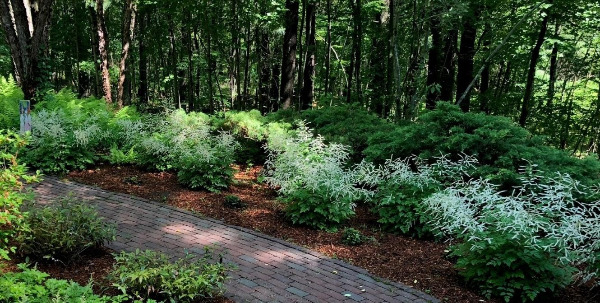
Ecological Landscaping and Tree Planting

Category

Land & Water

Impact

Cost

$
Spring is the perfect time to rethink your gardens and yards: Less mowing? More pollinator plants? Food production? Native trees? Fruit trees or even a small food forest? Even if you don’t have a yard, you can still bring biodiversity to shared spaces, schools, or places of worship. Here are 3 foundational principles for creating a native garden:
  1. Aim for 70-80% native biomass (more easily achievable by replacing alien trees and shrubs with native species)
  2. Give Keystone Species priority when choosing natives (Grow Native MA has a great list here).  They are species that support an especially large number of insects species and have an outsized impact on the ecosystem, with oaks and blueberries being particularly valuable.
  3. When creating a perennial flower garden, one doesn’t have to choose only native species.  It is also important – and pleasing to the eye – to have something flower at any time during the season, so adding some alien, pollinator-friendly species adds ecological value as well as visual beauty to your garden. Actually, adding ANY native plant species to your garden is a plus!

Steps to Take


  1. Learn & Plan
  2. Landscaping Services (Local or Regional)
    • Green Abundance by Design (Wayland/Sudbury area) – Website, Phone: 508-904-8484
    • Land of Plenty Gardens (Greater Boston area) – Website, Phone: 617-935-4025
  3. Food Forests: Contact the Boston Food Forest Coalition for guidance on establishing edible forest gardens.

Deep Dive

  1. How much carbon dioxide can a tree remove from the atmosphere? Over the course of a year, a young tree can remove approximately 6 kilograms/13 pounds of atmospheric carbon dioxide. By the time that tree is ten years old, the amount of carbon dioxide it can absorb jumps to 22 kilograms/48 pounds. Within 50 years, a mature tree has removed almost one ton of carbon dioxide.

How do trees help cool the atmosphere? Trees cool the atmosphere and ground around them through transpiration, the process through which plants absorb water through their roots and release water vapor through the pores of their leaves. On a sunny day, a mature tree can transpire up to 100 liters of water and in the process convert 70 kilowatt-hours of solar energy into latent heat held in water vapor. Without tree cover, the soil  absorbs heat instead. This contributes to a rise in temperature not only of the ground, but also the surrounding atmosphere1. What is a Food Forest? A food forest is an edible forest garden. A combination of tall trees, small trees, shrubs, herbs, ground covers, and some annual crops, it’s designed so that each plant receives sufficient sun exposure and requires minimal care as it enriches itself with organic matter. Far from a new idea, this is a time-tested system of farming found all over the world, perhaps most famously in the Amazon rainforest.

Testimonials

🫠 No testimonials yet. Be the first to share your thoughts!

Add a Testimonial

0%

Subscribe

* indicates required
Email Preferences
Topic Areas of Interest