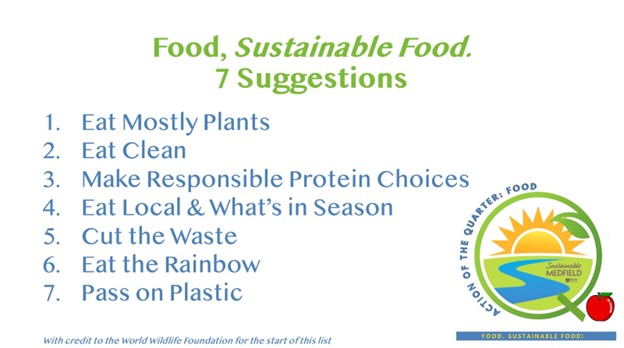
1. Eat Mostly Plants
Plants are good for you and good for the planet. Eating more plants is a win-win. Here are downtoearth.org’s top 10 reasons to go vegetarian. You will see here it says “mostly plants.” Everything in moderation. Maybe this is the first time you’ve considered eating more plants/less meat. It is really easy to get started. There are many resources for recipes and meals that are meatless; many of them you might not even notice are meatless. Cookie and Kate has 24 meatless recipes that carnivores love.
– Could you go meatless once a week? Then Meatless Mondays might be for you. Here are Meatless Monday tips.
– Could you have 1 meatless meal each day? Check out One Meatless Meal a Day for the Planet.
2. Eat Clean
Eating clean is a way to describe eating whole, natural foods that are free of additives and as close to their natural form as possible. The emphasis is on eliminating or at least minimizing packaged/processed foods to make room for more fruits, vegetables, whole grains and healthy animal options (free range pastured, grass fed). Check out WebMd’s 9 Ways to Eat Clean and these 7 tips from Eatingwell.com 7 Tips for Clean Eating
3. Make Responsible Protein Choices
When choosing to eat meat and seafood, which meat and seafood you choose can make a big difference.
– Choose antibiotic-free meat with no added hormones and packaged products with the least amount of ingredients. Learn more about a local company that delivers locally sourced and pesticide, antibiotic and herbicide-free meat to the greater Boston area.
– When choosing seafood, consider that The Environmental Defense Fund says “Overfishing is the most serious threat to our oceans.” Choose seafood products from sources that are committed to and certified to be using sustainable practices. Check out Seafoodwatch.org where you can easily learn the best varieties to purchase. It’s an easy to use tool you can use in the grocery store.
– And don’t forget protein-rich foods like beans, lentils, yogurt, nuts and tofu.
4. Eat Local & What’s in Season
Local food requires minimal transportation to get to you, which reduces the amount of greenhouse gasses required for your food. Local food is freshest and most often is less expensive than food trucked or flown to your community.
– In addition, choosing what is in season gets you the freshest and most nutritious food for your locale. When you choose a food that is not in season in your area (think Strawberries in December), the food has a big carbon footprint as it travels from far away. Additionally, eating by season gives you the opportunity to support local farmers and make foods that just feel right, like apple pie and root vegetable dishes in the fall, berry salads and desserts in the spring and summer, etc. Edible Boston is “The only magazine in Greater Boston devoted exclusively to local and sustainable food and the people who make it.” Check out Edible Boston.
5. Cut the Waste
Did you know that nearly 30% of all food is wasted? The MassDEP notes that 25% of the solid waste in Massachusetts is food. We could reduce the energy and resources needed to produce food, if there was not so much waste. According to Project Drawdown, reducing food waste is the most impactful action individuals and families can take. Purchase just what you plan to eat. One way to do that is to shop frequently for just what you need, and then choose produce that is available without packaging, so you can choose how much you want. And if you do have food waste, compost it! You can get a compost bin for your backyard and in Medfield you can bring food scraps (including things you can’t compost in your backyard) to the Transfer Station. Here’s information about the food scrap program at the Transfer Station.
6. Eat the Rainbow
Choosing a variety of fruits and vegetables to enjoy will provide you with a broad range of nutrients. Seeking out different colors can be fun and may introduce you to new things to eat. Who’d have thought Brussel Sprouts would have such popularity? Variety is the spice of life, right? With more than 100 vegetables and fruits to choose from, you’re sure to find something you like in every color of the rainbow. Check out this Harvard.edu resource.
7. Pass on Plastic
Plastic is convenient to use and can now be found virtually everywhere. But it also never goes away. It has been said that less than 10% of all plastics are recycled. Even when plastics are collected for recycling, over 30% does not even end up being recycled. Disposed plastic breaks down into smaller and smaller pieces of plastic, called microplastic, and can be found everywhere, including at the bottom of the Mariana trench, the deepest part of the Pacific Ocean. Sadly small pieces of ocean plastics are eaten by fish and birds. Then these animals are eaten by larger animals and the plastic proceeds up the food chain. Read more about microplastics here.
Here are a few tips to reduce the plastic in your food & meal processes.
- bring reusable produce and shopping bags with you when you shop. Just leave them in your car so they are always available
- choose produce that isn’t packaged in plastic
- select products with less/minimal packaging
- Here’s a link for some economical reusable produce bags. Reusable Produce Bag with Superior Overlock Stitch (6 Large Mesh Bags) – altCooking Hub
- Bring a collapsible silicone container for your restaurant leftovers.